


Apr 13, 2026
The feast day celebrated today, April 13, 2026, has its roots in the 14th century, a time when Europe was experiencing tension, religious conflict, and a constant sense of instability. It was then, in Valencia, that a figure was born who, over time, would be remembered not only as a preacher but also as a legendary figure: Saint Vincent Ferrer .

He was born in 1350 into a respected family and joined the Dominican order at a young age. He soon stood out for an uncommon ability: he spoke and people listened not only out of respect, but with the feeling that something deeper than a simple sermon was taking place.
Over time, his name spread far beyond Valencia. He traveled to cities in Italy, France, and Spain, drawing huge crowds. His contemporaries noted a remarkable fact: he preached in his native Valencian language, yet was understood by people from different places. This phenomenon was later interpreted as the "gift of tongues," and from then on, his figure became shrouded in a mixture of history and legend.
The path of the preacher and the birth of the myth
Vicente Ferrer's life was not one of seclusion, but of constant movement. During the last decades of his life, he traveled tirelessly throughout Europe, as if driven by a mission that allowed no pause.

His sermons went beyond the usual religious teachings. They spoke of fear, hope, the end times, and the need for inner transformation. For this reason, he became known as the "Angel of the Apocalypse," an image still reflected in his iconography today: the saint with his finger raised, pointing to the heavens.
Along with his words, stories of miracles began to circulate. They number in the hundreds, and many were collected during his canonization process. Stories of healings, unexpected salvations, and events that seemed to defy everyday logic.

Over time, these stories transformed into a cultural tradition. In Valencia, the so-called "miracles" of Saint Vincent are still performed—small theatrical representations in which children recreate episodes from his life. It is one of the few examples where a religious tradition has become a living part of popular theater.
From preacher to central figure of tradition

After his death in the French city of Vannes in 1419, his figure did not fade into oblivion. On the contrary, his influence continued to grow. In 1455 he was canonized by Pope Callixtus III, also from Valencia.
Since then, Vicente Ferrer has established himself as one of the most important figures in the religious and cultural tradition of the Valencian Community.
His legacy is not limited to preaching and miracle stories. He is also credited with concrete social actions, such as helping people in need and caring for orphaned children, at a time when such initiatives were uncommon.
A map that focuses on the Mediterranean
Over time, devotion to the saint became deeply rooted in his place of origin.

Today, the feast of Saint Vincent Ferrer is celebrated mainly in:
Valencia
towns in the Valencian Community
provinces of Alicante and Castellón
In these territories, their memory transcends the religious sphere and becomes part of daily life, through processions, performances, and popular traditions.
The date of the celebration is not fixed. It depends on the liturgical calendar and falls on the Monday following the second week after Easter, which means it varies each year.
One same spirit, different scenarios
In large cities, especially Valencia, the celebration takes on a more visible and festive character. Altars appear in the streets, the saint's miracles are reenacted, and the urban space is filled with activity, music, and processions.
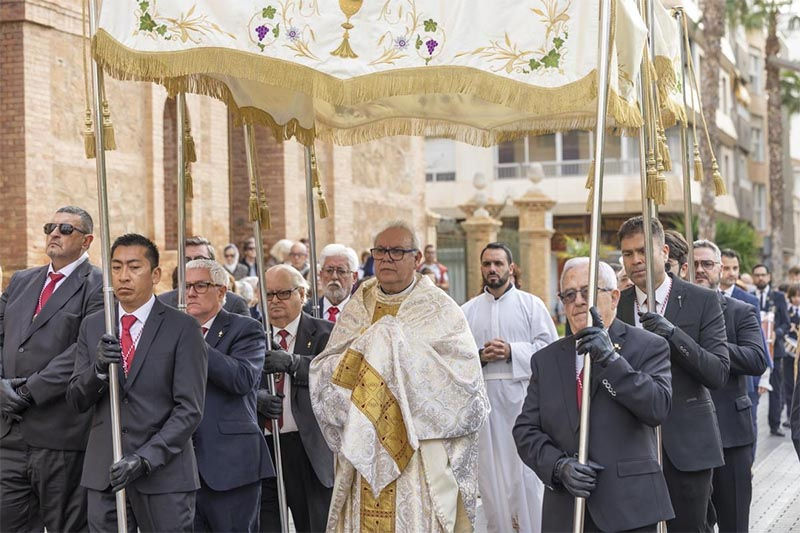
In towns like Torrevieja, the celebration unfolds in a more tranquil and intimate way. It takes place within a more subdued atmosphere, linked to religious tradition and the local community.
And yet, everywhere the same story remains: that of a man who traveled across Europe, spoke in his own language… and was understood by all.