


Feb 10, 2026
The year 2026 promises to be one of the most interesting of the last decade for those who enjoy observing the sky.
We can look forward to solar and lunar eclipses, spectacular planetary alignments, meteor showers and rare celestial configurations, many of which can be observed perfectly from Spain without the need for special equipment.
Let us calmly see what the future holds for us in the coming months.
🌞 Solar and lunar eclipses in 2026
🌘 17 February 2026 — annular solar eclipse
On that day, the Moon will not completely cover the solar disc, leaving a bright "ring of fire" visible..
🔹 Where it will be best seen: Antarctica, southern South America and part of Africa.
🔹 In Spain: The eclipse will be visible partially, as a slight darkening of the Sun.
🔹 Opening hours: In the morning, depending on the region.
⚠️ Important: observation of the Sun must be done only with approved solar filters.
🌕 3 March 2026 — total lunar eclipse (Blood Moon)
One of the most spectacular phenomena of the year.
During the eclipse, the Moon will enter completely into the Earth's shadow and take on a characteristic reddish hue.
🔹 Visible from:✔ Europe✔ Spain✔ Africa✔ Much of Asia
🔹 Observation time: The night of 2 to 3 March.
🔹 Equipment: No instruments are required; it is visible to the naked eye.
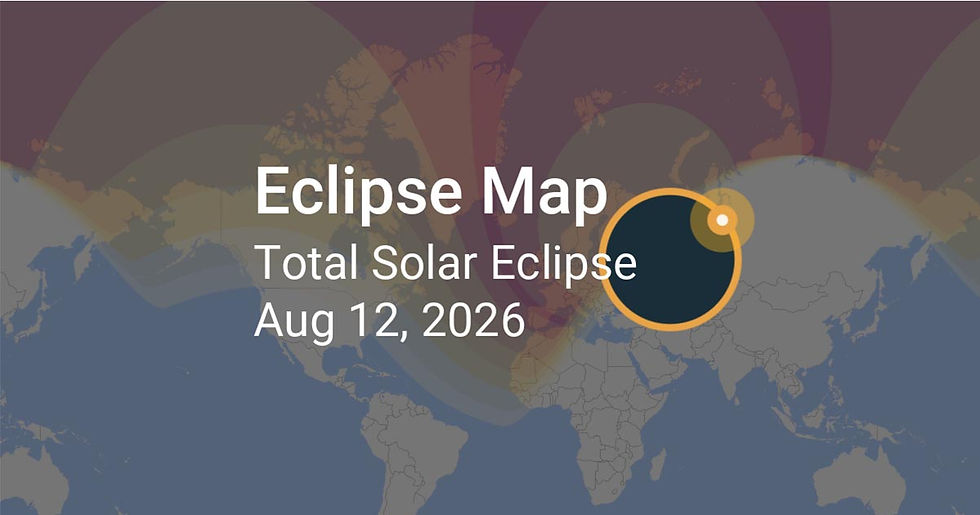
🌘 12 August 2026 — total solar eclipse
One of the most eagerly awaited astronomical events of the decade.
🔹 The total phase will be visible in:
Greenland
Iceland
North Atlantic Ocean
🔹 In Spain:It will be observed as a partial eclipse, especially visible in the north of the country.
It is undoubtedly one of the major astronomical events of the year.
🪐 Planetary alignments and "parades" in 2026
The year 2026 will be particularly generous in terms of planetary conjunctions and alignments, popularly known as 'planetary parades'.
🌅 January 2026 — morning line-up
🔭 Visible planets:
Venus
Marte
Mercurio
🕗 When to observe:Between 40 and 60 minutes before sunrise.
🧭 Where to look:Towards the eastern horizon, very low..
👁 Visibility:Perfectly visible to the naked eye. Binoculars enhance the experience.
📍 In Spain, it is particularly visible in the south and in areas with clear skies.
🌇 February–March 2026 — the great planetary parade

One of the most spectacular moments of the year.
✨ Planets visible simultaneously:
Mercurio
Venus
Mars
Júpiter
Saturno
🕖 Recommended time: Just after sunset.
🧭 Direction: Southwest.
👁 Visibility:
— Venus, Mars and Jupiter are clearly visible to the naked eye
— Saturn is easily visible
— Mercury appears low on the horizon
📍 From Spain, it will be one of the best planetary shows in recent years.
🌙 Summer 2026 — encounters between the Moon and the planets
During the months of June, July, and August, the Moon will pass very close to:
Venus
Júpiter
Mars
These encounters offer particularly photogenic scenes that are easy to observe.
🌠 Meteor showers in 2026

⭐ Perseidas — 12th and 13th of August
The most popular meteor shower of the year.
✨ Up to 100 meteors per hour🌙 Good viewing conditions📍 Visible throughout Spain
The best time is after midnight, away from light pollution.
⭐ Geminids — December 2026
One of the most intense and constant rains.
✨ Bright, slow-moving meteors📅 Peak in mid-December👁 Visible even from urban areas if the sky is clear
🔭 Is it necessary to use a telescope?
✔ Not essential
✔ Most phenomena are visible to the naked eye
✔ Binoculars enhance the experience
✔ A telescope allows you to observe details such as the phases of Venus or the rings of Saturn
✔ For photography, a camera with a tripod is sufficient
🌍 Why 2026 is such a special year
The Sun is near its peak activity.
Increased number of solar storms
More visible auroras
Several significant eclipses
Notable planetary alignments
Excellent viewing conditions from Spain
✨ Conclusion
The year 2026 will be a real treat for sky lovers..
You don't need to be an astronomer to enjoy:
eclipses,
planets aligned,
meteor showers,
and rare celestial phenomena.
Sometimes it is enough to go outside, look up, and remember that we live in a universe that is constantly moving..